
Onboarding Velocity as an Execution Multiplier
Onboarding Velocity as an Execution Multiplier: Why Federal Programs Fall Behind When Productivity Lags After Day One
In my previous posts, I made two core arguments about workforce execution in federal programs.
First, security clearance is a delivery gate that must be engineered into execution from day one. When clearance is treated as paperwork instead of an operational constraint, programs slip quietly, milestone by milestone.
Second, retention is not an HR issue, it is a delivery risk. When workforce stability wanes, execution erodes with it, regardless of what the headcount report says.
Together, those realities define how talent enters and remains within a program. But there is a third factor that determines whether programs deliver: how quickly people become productive once they arrive.
Onboarding velocity is an execution multiplier.
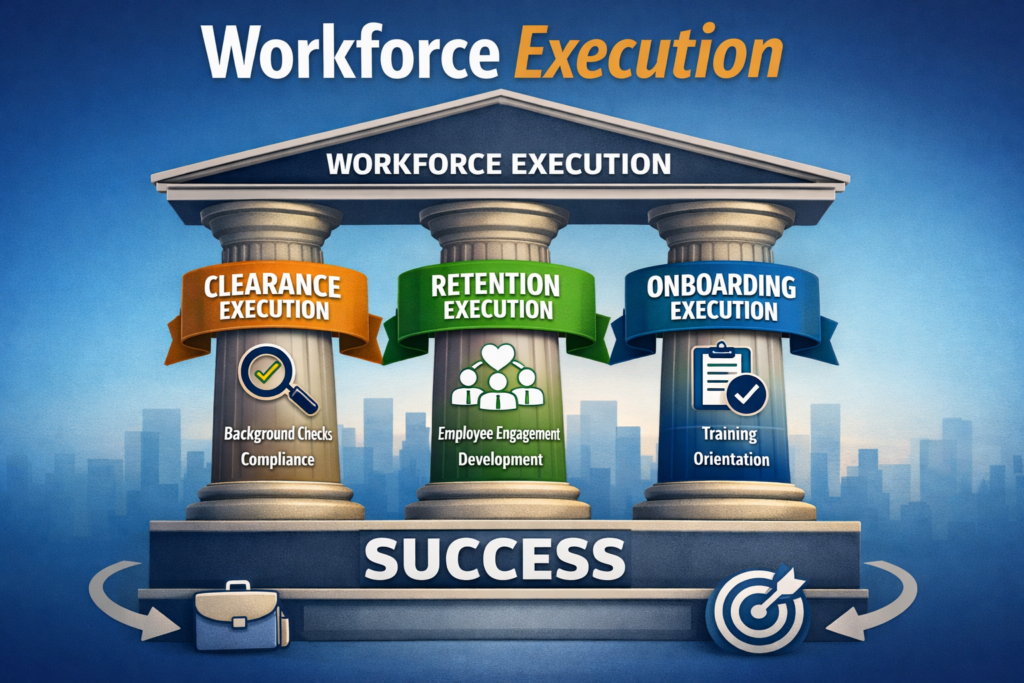
The Execution Model
- Clearance determines when people can enter
- Retention determines whether they stay
- Onboarding velocity determines how quickly they deliver
Programs that treat these as administrative steps create delay. Programs that integrate them create speed and predictability.
The Gap Between “Start” and “Deliver”
Federal programs often mark success when a role is filled: hired, cleared, onboarded. On paper, the position is staffed. In reality, execution is just beginning.
There is often a gap between start date and meaningful contribution. That gap is where programs lose time, momentum, and confidence.
It rarely shows up as failure. It shows up as lag.
Why Onboarding Slows Programs Down
In cleared environments, friction is common:
- Delays in access and credentials
- Misalignment between role and mission
- Disruptions to team productivity
- Disconnects between staffing, security, and delivery
The result is predictable: capable professionals who are present, but not productive. They are on the payroll, but not contributing.
That is not a utilization issue. It is an execution failure.
Slow onboarding also drives disengagement and ultimately attrition.
The Cost of Slow Starts
Low onboarding velocity compounds quickly:
- Schedules compress
- Performance and CPARs suffer
- Teams shift into reactive execution
- Rework increases
- Top performers disengage early
Programs don’t fall behind because people aren’t capable. They fall behind because people aren’t activated.
The Solution: How High-Performing Programs Accelerate Onboarding
High-performing programs engineer onboarding as part of execution:
- Align roles and work before Day One
- Integrate security, staffing, and delivery workflows
- Eliminate idle time through pre-staging and phased work
- Define early productivity expectations
- Hold leaders accountable for time-to-productivity
The goal is not just to onboard people. It starts with investing time in matching the candidate and the position and activating them quickly.
The Question Every Program Should Ask
The question isn’t whether your onboarding process is complete. It’s whether your program is designed and actively managed to turn new team members into productive contributors, quickly and consistently.
Because in Federal environments where time, access, and talent are constrained, speed to productivity is not a convenience.
It is a decisive competitive advantage.
This article was written by Doug Steele of SHC Federal on April 1st, 2026.