
A Security Clearance Is a Delivery Gate – Not a Checkbox
A Security Clearance Is a Delivery Gate – Not a Checkbox
For more than two decades, I have worked at the intersection of mission delivery, workforce execution, and security clearance processing in leading program transitions from award to execution where clearance timelines, access delays, and onboarding decisions directly determine whether a program starts strong or falls behind.
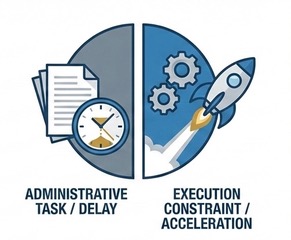
One lesson shows up every time: programs don’t fail because they can’t hire. They fail because execution breaks down. In cleared environments, that breakdown almost always happens when security clearance and onboarding are treated as administrative tasks instead of delivery requirements.
After more than 25 years writing clearance policy and leading clearance-dependent programs, I’ve seen the same issue across agencies and integrators. Teams spend months planning technology, staffing models, and contract structures. But when programs slip, the root cause is often simple: clearance was never built into the execution plan.
Which leads to a lesson that still catches teams off guard: clearance isn’t paperwork. It’s a delivery gate.
That distinction matters because federal programs rarely fail with a bang. More often, they slip quietly when they miss milestones, delay stand-ups, incomplete backlogs, and “temporary workarounds” that gradually become permanent.
Technology often takes the blame. But in clearance-dependent environments, the problem is usually more basic: clearances are managed like an administrative function instead of an execution constraint.
A streamlined clearance process matters more now than ever.
Cleared delivery has become less predictable, and not by accident. DOGE-style efficiency pushes across agencies have reshaped priorities, organizational structures, and approval paths, increasing variability in hiring decisions, onboarding timelines, and decision authority.
Layer in the stop-start disruption of a federal shutdown, and the complexity compounds. Decisions stall. Access provisioning slows. Onboarding stretches. Strong talent begins looking for stability elsewhere, even when mission work continues.
The combined effect is straightforward: variance increases. And when variance increases, clearances become a primary driver of schedule risk.
The clearance myths that persist
When clearances are treated as “someone else’s problem,” programs default to hope-based execution:
- Find someone already cleared
- Start uncleared and swap later
- Staff everything else first and fill cleared roles when possible
Sometimes that approach works. More often, it doesn’t. Operational demands increase without the cleared resources necessary to keep pace.
When it fails, the outcomes are predictable: schedule slip, quality degradation, rework, attrition, and erosion of customer confidence.
High-performing programs do it differently. They don’t react to clearance constraints after award. They design around them upfront.
That starts with modeling clearance demand early, distinguishing between roles that require day-one access versus phased access, sequencing onboarding to align with real work packages, and treating retention as a delivery risk—not just a people issue.
Security clearance processing is not a box to check. It is a system that must be actively managed, especially during periods of policy change, organizational restructuring, and budget volatility.
When clearance planning is built into execution from day one, programs stand up faster, stabilize sooner, and deliver with greater predictability—without unnecessary surprises.
Which part of the clearance process creates the most tension on your program today: recruiting, onboarding, access, or retention?
This article was written by Doug Steele of SHC Federal on January 9th, 2026.